Acting like Jonah
Trapped in the belly of something


The story of Jonah is bizarre - not just because of the whole big fish thing. For an Intermediate Greek class, we translated the short four chapters of Jonah, and I fell in love with this strange, dark comedy of an ancient text. Unexpectedly, I recently found myself having the character and attitude of Jonah (that’s not a good thing).
It had been decades since I heard, let alone read, Jonah. The story, as I had remembered it as a child, went something like this:
YHWH tells Jonah to go preach to a big, bad city (big cities were always evil)
Jonah refused and boarded a boat going in the opposite direction
YHWH sent a storm, prompting the sailors to throw Jonah overboard to appease God. It worked!
Jonah is swallowed by a whale and trapped inside for three days (take that science!)
Jonah prays to YHWH, and YHWH commands the whale to spit Jonah out on the shores of Nineveh
Jonah finally preaches to the city, and they all convert! The end.
After working through the translation, I was shocked to find that there was more to the story, both in the contextual details and in the ending.
A fish, not a whale
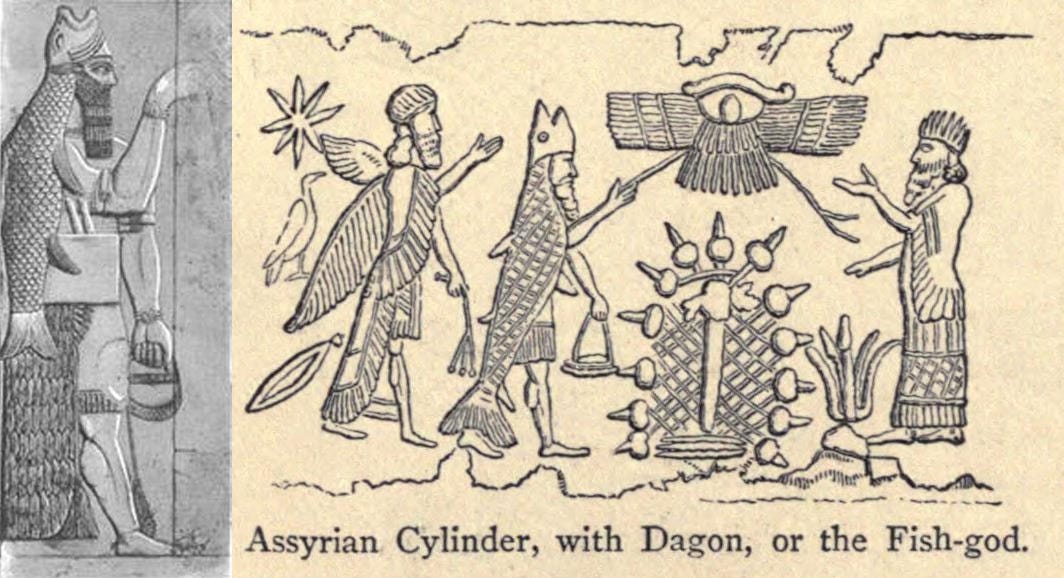
The Hebrew word for fish is ‘dag’ (דָּג). Dagon, depicted below with fish garments, was a major ancient Mesopotamian, Canaanite, and Northwest Semitic deity, worshipped from roughly 3000 BC as a creator and protector. In its Hebrew context, fishing for men is a savage thing. Every Old Testament instance of men fishing for a “human catch” involves violence. So in Hebrew, for someone to ‘dig’ (“fish”) for you, to hook or net you, means that your life, as you once knew it, is now over.
Original hearers of this story might have associated this great fish with Dagon and marveled at YHWH's power to command this mighty Assyrian god. For sure, Jonah’s life as he knew it was over.
Nineveh, Capital of Ass(yria)–holes
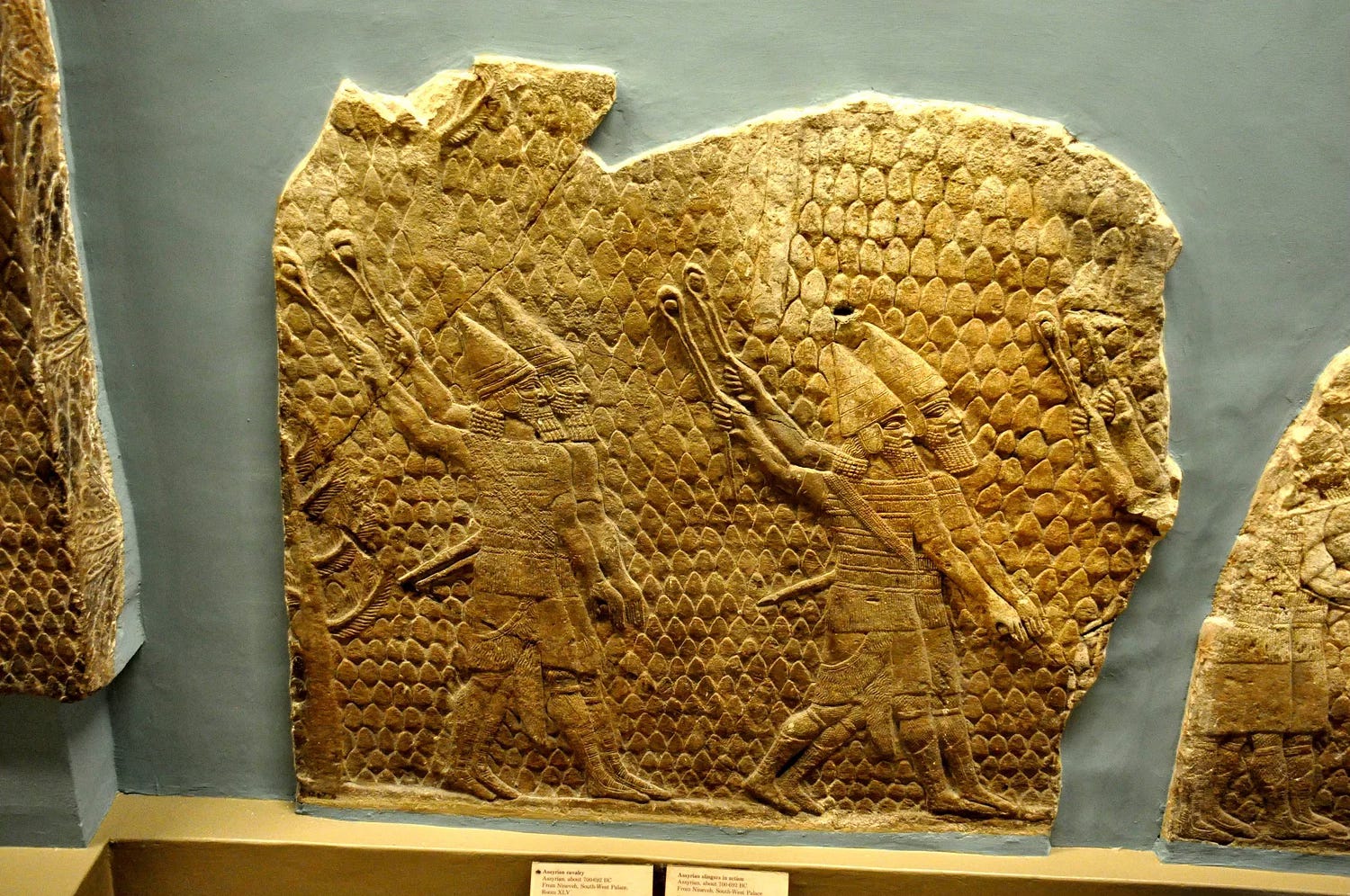
Nineveh was the capital of Assyria, an ancient superpower known for its brutal conquests (like all Empires throughout history). The Bible and the archaeological record document how this Empire conquered the Northern tribes and reduced Judah into a vassal state. The brutal siege of Lachish contributed to Judah’s decision for vassalage.
Jonah’s Sassy Prayer and Uninspired Sermon
While in the belly of the great fish, Jonah prays to YHWH. But he doesn’t promise to do what YHWH asked of him. Rather, he promises to offer a sacrifice at the temple. Note verse eight and nine:
Jonah prayed to the Lord his God from the stomach of the fish 2 and said,
“I called out to the Lord from my distress,
and he answered me;
from the belly of Sheol I cried out for help,
and you heard my prayer.
3 You threw me into the deep waters,
into the middle of the sea;
the ocean current engulfed me;
all the mighty waves you sent swept over me.
4 I thought I had been banished from your sight
and that I would never again see your holy temple.
5 Water engulfed me up to my neck;
the deep ocean surrounded me;
seaweed was wrapped around my head.
6 I went down to the very bottoms of the mountains;
the gates of the netherworld barred me in forever,
but you brought me up from the Pit, O Lord, my God.
7 When my life was ebbing away, I called out to the Lord.
And my prayer came to you, to your holy temple.
8 Those who worship worthless idols forfeit the mercy that could be theirs.
9 But as for me, I promise to offer a sacrifice to you with a public declaration of praise;
I will surely do what I have promised.
Salvation belongs to the Lord!”10 Then the Lord commanded the fish and it vomited Jonah out onto dry land. (Jonah 2 NET)
Jonah is rescued. Again, he is called to proclaim a message. Having learned his lesson not to run, Jonah obeys, but you can tell his heart’s not in it. I imagine Jonah walking the streets of Nineveh, mumble-whispering this message because he doesn’t want to be there. According to his prayer, the whole city worships worthless idols and has forfeited its mercy.
Now Nineveh was an enormous city—it required three days to walk through it! 4 Jonah began to enter the city by going one day’s walk, announcing, “At the end of forty days, Nineveh will be overthrown.” (Jonah 3:3-4 NET)
Fasting from Animals
Despite Jonah’s lackluster performance, a revival moves throughout the city. Not only did the humans of Nineveh repent and fast, but so did their livestock!
6 When the news reached the king of Nineveh, he got up from his throne, took off his royal robe, put on sackcloth, and sat on ashes. 7 He issued a proclamation and said, “In Nineveh, by the decree of the king and his nobles: No human or animal, cattle or sheep, is to taste anything; they must not eat and they must not drink water. 8 Every person and animal must put on sackcloth and must cry earnestly to God, and everyone must turn from their evil way of living and from the violence that they do. (Jonah 3:6-8 NET)
How absurd! Even the animals were clothed in sackcloth, the humiliating garment of the penitent. I think it’s silly to dress pets up, but how much more a flock of sheep wearing burlap?
The Ending
The fourth and final chapter of Jonah was all new content to me. After the entire city repents, fasts, and humbles themselves with sackcloth, Jonah, a great prophet of YHWH, responds:
This displeased Jonah terribly and he became very angry. 2 He prayed to the Lord and said, “Oh, Lord, this is just what I thought would happen when I was in my own country. This is what I tried to prevent by attempting to escape to Tarshish, because I knew that you are a gracious and compassionate God, slow to anger and abounding in mercy, and one who relents concerning threatened judgment. 3 So now, Lord, kill me instead, because I would rather die than live!” 4 The Lord said, “Are you really so very angry?”
5 Jonah left the city and sat down east of it. He made a shelter for himself there and sat down under it in the shade to see what would happen to the city. 6 The Lord God appointed a little plant and caused it to grow up over Jonah to be a shade over his head to rescue him from his misery. Now Jonah was very delighted about the little plant.
7 So God sent a worm at dawn the next day, and it attacked the little plant so that it dried up. 8 When the sun began to shine, God sent a hot east wind. So the sun beat down on Jonah’s head, and he grew faint. So he despaired of life and said, “I would rather die than live!”
9 God said to Jonah, “Are you really so very angry about the little plant?” And he said, “I am as angry as I could possibly be!” 10 The Lord said, “You were upset about this little plant, something for which you did not work, nor did you do anything to make it grow. It grew up overnight and died the next day. 11 Should I not be more concerned about Nineveh, this enormous city? There are more than 120,000 people in it who do not know right from wrong, as well as many animals.”
And then it just stops! The story doesn’t tell us what happened to Jonah. We are left with a prophet wishing he were dead because YHWH was gracious and compassionate. Who’s the ass(yria)-hole now?
In this season of life, I understand the message of Jonah this way.
We ask God for clarity about the big things in life. But when we finally get it, it’s often disappointing. That insight, from Tish Warren’s interview in the Practicing the Way course, has hit me hard. We want to be the stars of our own movie, not the janitors cleaning the bathrooms.
In our disappointment, we refuse to partner with God and try to make our own way. As a result, we become trapped in unfulfilling scenarios of our own making. Like Jonah, we need to be thrown off and vomited out, as it were. What a messy, painful experience! But once we’re back on dry ground, when we reach the end of our selfish pursuits, we have the choice to become a joyful partner using what we have been uniquely crafted to do. Or we can become an insufferable wise ass.
In the Belly of Something
Like Jonah, I think I’ve been running away from what God has called me to do and, as a result, have felt trapped in the belly of something. As I reflect on my misreadings of what I thought I should pursue next, I see pride. I thought I was being called to visibly lead - whether that was on study trips, small group Bible studies, or maybe even a kind of church. But regional conflicts, lack of interest, and an aversion to yet another church plant have stalled these pursuits.
A good way to see the future is to turn around and look in the past. Everything in my past has placed me behind a camera, in front of a computer, or at home raising kids. In short, behind the scenes. Perhaps this tension between desire and reality is where my critical tendencies toward the church and her leaders originate: it’s an admiration that turns into jealousy of those who have what I wish I could be but know I am not gifted or wired or called to become. The frustration has led to a lot of anger and disconnection across areas of my life.
Perhaps I need to lean into what has already been set before me.
I’ve started to listen for when people tell me, “I could never do that,” “That’s amazing,” or “I really enjoyed what you did.” This seems to be a good indicator of what I might be uniquely wired to do, especially if that thing comes easily or energizes me. I have heard this response to foster parenting, turning ideas into usable technology, and writing.
For me, foster parenting is in that messy, painful experience right now. With a case that is seemingly stalled for two young boys, including a three-year-old struggling to potty train, our days literally revolve around piss, shit, and frustration. What. A. Mess. It has at times felt like being trapped in doing what you know you should do, but selfishly not wanting to do anymore.
Yet here I am, vomited out on the shoreline amongst all the flotsam of brokenness, holding the tiny hands of whom God has told us to love. Will I be like Jonah, the insufferable wise ass? Or will I be that joyful partner God needs me to be in order for us to extend mercy and compassion?
For me to be that joyful partner for these boys, I think it means sacrificing the things that I thought I should pursue but have not materialized. Perhaps, in submitting to this humbling and noble task, God is shaping my heart and attitude for what lies ahead. You need to lose your life to find it.
We forget that the monks who hand-copied Scripture for centuries in cold, dark, and lonely rooms, without recognition, did much for our faith. May you find joy in the everyday grind, what Tish Warren calls the “liturgy of the ordinary,” as we walk with God and tend our little gardens so that life can thrive.